

At a Glance
A new knocking noise from your car is hard to ignore, especially when you have no idea where it’s coming from.
Sometimes it’s something fairly simple. Other times, it can be a sign that a part of the suspension, steering, engine or another component is starting to wear.
When you hear the knock can tell you a lot. Does it happen over bumps? When you turn? As you accelerate or brake? Paying attention to when it happens can make it much easier to work out what’s going on.
Most of us get pretty used to the normal noises our cars make.
That’s why when a new knock or clunk suddenly appears, it tends to stand out.
The frustrating part is that there isn’t one single cause. A knock from underneath the car when you go over a speed bump could be completely different to one you hear when accelerating.
So rather than trying to guess from the noise alone, it’s worth thinking about exactly when you hear it.
Knocking When Driving Over Bumps
If you mainly hear the knocking when you go over potholes, speed bumps or rough patches of road, there’s a good chance it’s coming from somewhere around the suspension.
Your suspension takes a fair amount of punishment over the years, particularly if you regularly drive on roads that aren’t exactly smooth.
As components wear, they can develop a little more movement than they should, which is often when those knocks and clunks start appearing.
Worn bushes, ball joints, anti-roll bar links and shock absorber components are all possible causes.
At first, you might only hear the noise when you hit a particularly bad pothole. Over time, though, it can become more noticeable on everyday roads.
You may also find the car doesn’t feel quite as settled as it once did.
Knocking When Turning
A knocking or clicking sound while turning can come from the steering, suspension or parts that transfer power to the wheels.
You might notice it when pulling out of a junction, turning into a side road or manoeuvring into a parking space.
One possible cause is a worn CV joint. These allow power to be transferred to the wheels while still letting them turn and move up and down with the suspension.
But that’s not the only possibility.
Several steering and suspension components can make similar noises when they’re worn, which is why it’s difficult to diagnose the problem from the sound alone.
If it seems louder when turning one way rather than the other, make a mental note of it. That’s useful information when the car is inspected.
Knocking When Accelerating

A knock that appears when you accelerate can be particularly difficult to pin down.
Sometimes the noise can come from the engine itself. In other cases, worn engine or gearbox mounts may be allowing more movement than they should.
These mounts hold the engine and gearbox securely in place while also helping to absorb vibration.
When they start to wear, the engine can move slightly as you accelerate or lift your foot off the pedal, sometimes creating a noticeable knock or clunk.
You might also feel more vibration through the car than you used to, particularly when pulling away or changing gear.
Knocking When Braking
If you hear a knock when you press the brake pedal, it’s worth paying attention to.
Braking shifts the weight of the car forwards and puts extra force through several components. If something is worn or has developed too much movement, that can sometimes be when you hear it.
The braking system itself could be responsible, but worn suspension components can create similar noises too.
If the knock comes with vibration, the car pulling to one side or the brakes feeling different under your foot, it’s best to get it checked sooner rather than later.
Engine Knocking
If the noise seems to be coming from under the bonnet rather than underneath the car, the engine itself could be involved.
There are lots of moving parts working away inside an engine, so a knocking sound can have several different causes.
You might find the noise gets faster as the engine revs increase or becomes more noticeable when you accelerate.
This isn’t really one to diagnose by ear and hope for the best.
If you’ve noticed a new knocking sound from the engine that doesn’t go away, getting it looked at is the safest option.
Worn Engine or Gearbox Mounts
Engine and gearbox mounts are probably not something you’ve ever thought much about.
And usually, there’s no reason to.
They’re there to hold the engine and gearbox securely in place while stopping too much vibration from making its way into the cabin.
When a mount starts to wear, you may hear a clunk as the engine moves more than it should.
It can be particularly noticeable when:
- Pulling away
- Accelerating
- Changing gear
- Lifting off the accelerator
- Starting or switching off the engine
You may also notice more vibration inside the car than usual.
Loose Exhaust Components
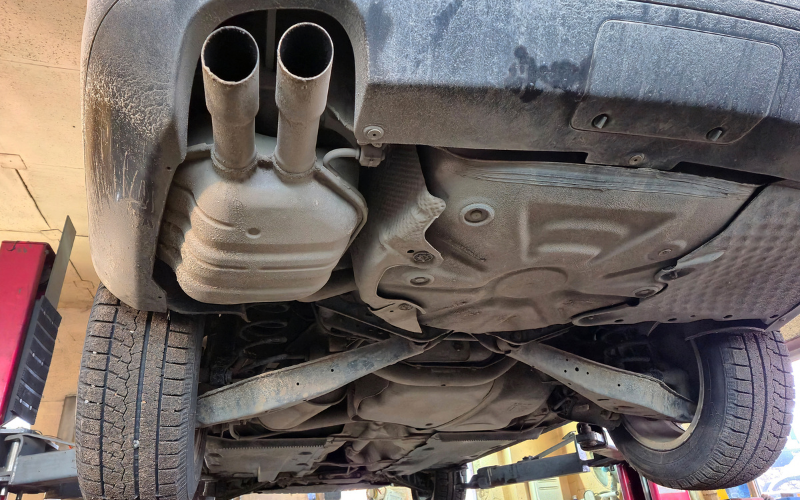
Sometimes the knock is coming from something much simpler.
Your exhaust runs underneath a large part of the car and is held in position by various brackets and mountings.
If one of those becomes loose or damaged, the exhaust can move around and occasionally knock against the underside of the vehicle.
A loose heat shield can make a similar noise.
You may hear it more when going over bumps, accelerating or starting the engine.
And because the sound travels through the body of the car, it can seem like it’s coming from somewhere completely different.
Could It Just Be Something Loose?
Before you start imagining an expensive repair bill, check the obvious things.
It sounds silly, but a bottle rolling around in the boot, something underneath a seat or even an item moving around in a door pocket can make a surprisingly convincing knocking noise.
Empty out anything that could be moving around and take the car for another drive.
If the knock has disappeared, you’ve found the cheapest possible solution.
If it’s still there, at least you’ve ruled that one out.
Is It Safe to Drive With a Knocking Noise?
There’s no single answer because it depends on what’s actually causing the noise.
Something rolling around in the boot obviously isn’t a problem.
A worn suspension component, braking fault or engine problem is a different story.
That’s why it’s worth paying attention to anything else that changes at the same time.
If the steering feels different, the brakes aren’t behaving normally, the car becomes difficult to control or the knocking suddenly gets much louder, don’t keep driving unnecessarily.
Get the vehicle checked instead.
When Should You Get It Checked?

Hearing one small knock doesn’t necessarily mean you need to panic.
But if it keeps happening, starts getting louder or comes with another symptom, it’s worth finding out what’s behind it.
Try to remember exactly when you hear the noise.
Is it only over bumps? When you brake? When you first pull away? Does it get faster when the engine revs?
Those little details can be really helpful when a technician is trying to recreate the problem.
And as with most things on a car, finding a worn component early is usually better than waiting until it becomes a bigger problem.
Get That Knocking Noise Checked at In Town Automotive
Cars make plenty of noises, and not every knock means something serious is wrong.
But if yours has suddenly started making a sound you’ve never heard before, it’s worth finding out why.
At In Town Automotive, our experienced technicians can inspect your vehicle and track down where the noise is coming from. Whether it’s the suspension, brakes, steering, engine, exhaust or something else entirely, we’ll find the cause and let you know what needs attention.
If that knocking noise isn’t going away, get in touch with In Town Automotive today and we’ll take a look.

